India may have the world’s fastest growing wireless market, but Apple (AAPL) didn’t set its hopes particularly high when it launched the iPhone 3G there in August. It reportedly shipped only 50,000 units to its partners on the subcontinent, with plans to double that number by the end of the year.
If so, those partners may have a lot of unsold iPhones on their hands come January. According to a long postmortem published this week in the Delhi-based newspaper Mint, Apple has sold only 11,000 iPhones in India, a country of 1.14 billion that buys 8 to 10 million cellphones a month.
“IPhone’s launch in India has been dubbed the biggest failure of a top-notch brand from a well regarded company in recent times,” wrote Priyanka Mehra and Shauvik Ghosh in a piece that underscores the difficulty of adapting Apple’s U.S.-based smartphone strategy to markets around the world.
Price, according to the authors, is only part of the problem. Although most Indians buy cheap cellphones on a pre-paid basis, there were plenty of potential customers who could afford the 31,000 rupees ($716 at the time) that Bharti Airtel and Vodafone Essar were charging for the 8GB iPhone. According to Mint, Nokia (NOK), Samsung and RIM (RIMM) are all doing good business in India selling smartphones that cost even more.
But Steve Jobs had announced before the launch that Apple would be priced at $199 globally — less than 10,000 rupees — a promise he couldn’t deliver on in India because local cellphone companies don’t subsidize cellphones with lock-in clauses the way carriers routinely do in the United States and Europe.
“This built a false hope in the minds of those consumers who wanted to buy it and turned away those who could have actually bought it,” Prathap Suthan, creative director of advertising agency Cheil Communications India, told Mint.
Moreover, he says, Bharti and Vodafone, lacking experience in the complex Indian retail environment, dropped the ball in terms of marketing and distribution. By selling iPhones exclusively at their own outlets, they’ve antagonized the big retail chains that dominate the market in India.
“A brand like Apple need not be told that an iconic product needs iconic advertising, a solid marketing push,” says Suthan, “The company failed to strike a connect with Indian consumers.”
Saturday, November 15, 2008

Saturday, September 6, 2008
New Strategy by Hotspot and other retailers
Organised mobile retailers like HotSpot and Mobile NXT have found a new way to deal with competition from mom & pop stores: make neighbourhood retailers their franchisees to sell mobile phones and accessories under their brand.
Currently, more than 70% of the mobile retail sector is unorganised and market analysts believe there is a huge potential for the franchise model. “The return on investment (RoI) for the franchisee is somewhere around 60-65%.
It will allow us to expand our presence and enter deep into the cities,” says HotSpot CEO Sanjeev Mahajan. HotSpot has recently adopted the franchise model with 25 stores operational in Delhi alone and has plans to expand to 100 such stores besides the 400 company-owned, company-operated (co-co) stores across the country.
“Customer experience and pricing is the crux of this business. Therefore, we provide stock management, professional training for the in-store sales team, and an after-sales customer support at all our franchised stores. The role of the franchisee is restricted to the operational level,” says Mobile NXT CEO Vijay Menon.
Mobile NXT adopted the franchise model in tier-II and tier-III cities across India in 2007. The company operates more than 55 stores all over the country.
Mr Menon, however, concedes that the franchise model in mobile retailing is difficult to adopt since there is no uniqueness in the product and the return on investment is not very attractive.
That is why players like Subhiksha and Mobile Store are refusing to join the bandwagon. They believe the franchise model is not profitable at this stage, given the low profit margins and low market penetration.
“We are concentrating on a co-co model based on pricing. We don’t think franchise model is the way to go, since the business already accounts for low margins; expanding through franchise would dent the margins further,” says Subhiksha president-marketing Mohit Khattar. Subhiksha operates the largest chain of mobile stores with around 1,300 stores all over the country.
Mobile Store CEO Rajiv Agarwal also feels that the franchise model in the current scenario does not hold much ground. “There is the risk of our brand value being diluted. This is a business where you cannot allow your service proposition to get diluted,” says he. Mobile Store has significant presence in the country with more than 800 stores.
However, RPG Cellucom head-marketing Biswajit Pandey feels that with improving margins and marketing strategies, the franchise model may take the front stage in future. The company currently operates over 25 stores.
“It’s a win-win situation since it allows rapid expansion and presence in local areas for the franchiser and an opportunity for the traditional retailer to enter the newfound trend of organised retail. Moreover, the operational costs in case of franchise model is low in comparison to co-co model, giving both the parties a better RoI,” says global management consulting firm Technopak chairman Arvind Singhal.
Currently, more than 70% of the mobile retail sector is unorganised and market analysts believe there is a huge potential for the franchise model. “The return on investment (RoI) for the franchisee is somewhere around 60-65%.
It will allow us to expand our presence and enter deep into the cities,” says HotSpot CEO Sanjeev Mahajan. HotSpot has recently adopted the franchise model with 25 stores operational in Delhi alone and has plans to expand to 100 such stores besides the 400 company-owned, company-operated (co-co) stores across the country.
“Customer experience and pricing is the crux of this business. Therefore, we provide stock management, professional training for the in-store sales team, and an after-sales customer support at all our franchised stores. The role of the franchisee is restricted to the operational level,” says Mobile NXT CEO Vijay Menon.
Mobile NXT adopted the franchise model in tier-II and tier-III cities across India in 2007. The company operates more than 55 stores all over the country.
Mr Menon, however, concedes that the franchise model in mobile retailing is difficult to adopt since there is no uniqueness in the product and the return on investment is not very attractive.
That is why players like Subhiksha and Mobile Store are refusing to join the bandwagon. They believe the franchise model is not profitable at this stage, given the low profit margins and low market penetration.
“We are concentrating on a co-co model based on pricing. We don’t think franchise model is the way to go, since the business already accounts for low margins; expanding through franchise would dent the margins further,” says Subhiksha president-marketing Mohit Khattar. Subhiksha operates the largest chain of mobile stores with around 1,300 stores all over the country.
Mobile Store CEO Rajiv Agarwal also feels that the franchise model in the current scenario does not hold much ground. “There is the risk of our brand value being diluted. This is a business where you cannot allow your service proposition to get diluted,” says he. Mobile Store has significant presence in the country with more than 800 stores.
However, RPG Cellucom head-marketing Biswajit Pandey feels that with improving margins and marketing strategies, the franchise model may take the front stage in future. The company currently operates over 25 stores.
“It’s a win-win situation since it allows rapid expansion and presence in local areas for the franchiser and an opportunity for the traditional retailer to enter the newfound trend of organised retail. Moreover, the operational costs in case of franchise model is low in comparison to co-co model, giving both the parties a better RoI,” says global management consulting firm Technopak chairman Arvind Singhal.
Wednesday, August 27, 2008
3G rule tweak to help CDMA players
Entry costs for 3G services in the CDMA platform are likely to be lower as the government takes steps to modify auction rules for CDMA operators.
Top telecom officials said a limited bidding among a few CDMA players, led by Reliance and the Tatas, was likely to ensure a lower price per circle compared with GSM bids for the same circle.
According to the earlier rule, 3G licences would be allocated to the CDMA player with the highest subscriber base provided it was willing to pay the same price that the biggest GSM operator was paying in that particular circle. In CDMA, therefore, auctions were not necessary.
“This (GSM price) would have been high considering the large number of domestic and foreign GSM players keen on entering the fast growing Indian telecom sector,” said telecom analyst Sudipto Basu.
Analysts also contend that with only one slot available in the coveted 800 megahertz (Mhz) band, few domestic and international players will want to enter the CDMA auction, leading to lower bidding rates. “Besides, far fewer players exist in the CDMA space compared with GSM mobile telephony,” Basu said.
Reliance Communications, Tata Teleservices, Bharat Sanchar Nigam Ltd and new entrant Sistema-backed Shyam Telecom are the main contenders for third-generation CDMA rollout.
Mahesh Uppal, director of Com First (India), said, “Auction of 3G CDMA spectrum will bring in transparency in the system and reveal the market price for CDMA radiowaves.”
The government has also decided to fix the base price for 3G frequencies in the 800MHz band at a fourth of what GSM operators will pay for 3G frequencies. The base price for 1.25 MHz of radiowaves in the 800MHz band will be Rs 40 crore for metros and category A circles, Rs 20 crore for category B circles and Rs 7.5 crore for category C circles.
While the department of telecom (DoT) has made additional provision for allocating spectrum in the 450MHz and the 1900MHz bands for CDMA operators, technical experts said that these bands were inferior compared with the 800Mhz band.
Auction schedule
The DoT today revised the time schedule for the process to appoint an agency for the 3G e-auction. The pre-bid conference for receiving the request for proposals for the designated agency was to start tomorrow.
It will now start on September 8 and consequently all the earlier dates have been revised. The submission of technical and financial bids will be on September 22 instead of September 3, said an official statement.
Nokia N85

Specs & features:
• 2.6-inch OLED screen
• N-Gage gaming
• Music with in-built FM transmitter
• 5 megapixel auto-focus camera
• Carl Zeiss optics
• Dual LED flash
• Geotagging
• 3.5G HSDPA
• Wi-fi
• Bluetooth (A2DP)
• 8GB microSD card
• RDS radio
• 3.5mm audio jack
• A-GPS support
“The Nokia N85 was created to be more than the sum of its parts, offering a complete mobile entertainment package designed for connecting, sharing and discovering,” said Juha-Pekka Sipponen, Director, Nokia N-series. “The iconic Nokia N-series dual slider design has evolved to become smaller and sleeker while integrating the newest features and services to deliver the best mobile experience to date.”
The Nokia N85 is pre-loaded with at least 10 made-for-mobile N-Gage gaming titles and a voucher to activate one full game license. Dedicated gaming keys light up when the device is in landscape gaming mode to further enhance a user’s gaming experience.
The new Nokia N79 multimedia smartphone is both lighter and more capable than its predecessor, the N78
Nokia today unveiled the Nokia N79 candybar multimedia smartphone, which joins the Nokia N85 as the latest additions to the Nokia Nseries range. The Nokia N79 offers a full range of multimedia capabilities, including integrated navigation, music with FM transmitter, high-speed connectivity, web browsing and a 5-megapixel camera.
Aimed at style conscious users who don't want to compromise on functionality, the Nokia N79 comes with Xpress-on smart covers that are available in five colors: Light Sea Blue, Espresso Brown, Olive Green, White and Coral red. A combination of three of these comes with each Nokia N79.
The Nokia N79 sports a 5-megapixel camera with Carl Zeiss optics, though the lens is slightly less capable than the one found in camera phones such as thesony ericsson c905 and the nokia N82. Still, the Nokia N79 offers a range of camera features such as autofocus, dual LED flash and VGA video recording. Images can also be geotagged to specific locations. The Nokia N79 comes packaged with a 4GB microSD card, and a sliding lens cover helps protect the lens when not in use.
A Friendster widget will also be made available for the Nokia N79 via the WidSets service. This will allow users to browse Friendster friends' profiles, view and post shoutouts, upload pictures taken with their handset, and browse their own and friends' photo albums. Furthermore, the Nokia N79 will offer the Nokia Download! store, which offers third party entertainment content, the latest in mobile gaming and dynamic applications (widgets).
Nokia Maps lets users explore and navigate new surroundings by accessing more than 15 million points of interest (POI). Built-in AGPS providing turn-by-turn navigation comes with a three month integrated license on the Nokia N79.
The convergence of photos, music and navigation in the Nokia N79 is combined with high-speed 3.5G HSDPA and Wi-Fi. Additionally, the Nokia N79 features the Nokia Mini Map browser, Bluetooth 2.0, TV out (video cable sold separately), and DLNA support.
The Nokia N79 boasts a 2.4" screen, a talk time up to 3.5 hours and operates on Quadband GSM and HSDPA networks. The phone measures 4.3 by 1.93 by 0.59 inches and weighs 3.42 ounces, making it slightly lighter yet more capable than the Nokia N78. Compare the two smartphones here.
The Nokia N79 is expected to hit European store shelves in October 2008 for 350 euro, while it should appear in the U.S. in November 2008 for approximately $500.
Aimed at style conscious users who don't want to compromise on functionality, the Nokia N79 comes with Xpress-on smart covers that are available in five colors: Light Sea Blue, Espresso Brown, Olive Green, White and Coral red. A combination of three of these comes with each Nokia N79.
The Nokia N79 sports a 5-megapixel camera with Carl Zeiss optics, though the lens is slightly less capable than the one found in camera phones such as thesony ericsson c905 and the nokia N82. Still, the Nokia N79 offers a range of camera features such as autofocus, dual LED flash and VGA video recording. Images can also be geotagged to specific locations. The Nokia N79 comes packaged with a 4GB microSD card, and a sliding lens cover helps protect the lens when not in use.
A Friendster widget will also be made available for the Nokia N79 via the WidSets service. This will allow users to browse Friendster friends' profiles, view and post shoutouts, upload pictures taken with their handset, and browse their own and friends' photo albums. Furthermore, the Nokia N79 will offer the Nokia Download! store, which offers third party entertainment content, the latest in mobile gaming and dynamic applications (widgets).
Nokia Maps lets users explore and navigate new surroundings by accessing more than 15 million points of interest (POI). Built-in AGPS providing turn-by-turn navigation comes with a three month integrated license on the Nokia N79.
The convergence of photos, music and navigation in the Nokia N79 is combined with high-speed 3.5G HSDPA and Wi-Fi. Additionally, the Nokia N79 features the Nokia Mini Map browser, Bluetooth 2.0, TV out (video cable sold separately), and DLNA support.
The Nokia N79 boasts a 2.4" screen, a talk time up to 3.5 hours and operates on Quadband GSM and HSDPA networks. The phone measures 4.3 by 1.93 by 0.59 inches and weighs 3.42 ounces, making it slightly lighter yet more capable than the Nokia N78. Compare the two smartphones here.
The Nokia N79 is expected to hit European store shelves in October 2008 for 350 euro, while it should appear in the U.S. in November 2008 for approximately $500.
Monday, August 25, 2008
LG launches CDMA LG10000 to take on iPhone
 The competition for the Iphone seems to be getting hotter by the day. After a slew of releases by GSM band competitors now LG has launched a CDMA Handset to compete with it. The LG10000 can be used on the Reliance mobile network in India. It is a clamshell model with a 2.8 inch touchscreen and QWERTY keyboard.
It has a memory of 8 GB and a 2 megapixel camera. The phone is compatible with Microsoft Exchange Server and is capable of HTML browsing. It has 240 minutes of talk time and 480 minutes of standby time.
The phone has been in the US markets for some time now and is being sold as Voyager. It has been one of the main competitors to Iphone. The war for market share has shifted to India with this launch.
The phone is likely to be priced between Rs 22,000 and Rs 25,000. It will be available in all reliance exclusive and retail outlets.
Saturday, August 23, 2008
Samsung Mobile eyes 15% market share
Samsung Telecommunications India, the number two mobile handsets maker in the country, plans to double its market share in the next 10 months by increasing mobile manufacturing capacity at its Noida plant.
At its Noida unit, Samsung Telecom plans to increase capacity from 9,00,000 units to 1 million units per month this year.
Sunil Dutt, country head at Samsung Telecom, said the firm is targeting a 15% market share in India within 8-10 months through increasing capacity, greater communication with consumers and expansion of its distribution channels. "We have more than 300 distributors in the country," he said.
The company has up to 60% volume coverage in the country and commands a market share of 8% in the mobile handsets segment.
"We have almost 40 models in the market across every price segment and will soon launch a new model 'Omnia', which is Samsung's answer to other high-end phones," Dutt said. The company will focus on rural areas and first-time and new consumers there.
"In rural areas, beyond 5,100 towns, our share is slightly less than our national share, and that is expected to grow as we are building our infrastructure there," Dutt said.
Samsung Telecom is also expanding through retail outlets such as Sangeetha, Subhiksha, Mobile Store, Hot Spots, Reliance Retail, Croma and others and plans to launch a limited number of Samsung mobile exclusive stores. "We don't have exclusive stores for mobiles right now but we may plan a limited number of stores," Dutt said.
The company is targeting a 30% growth for 2008. It contributes 30% to Samsung India's revenues of over $1 billion.
Samsung Telecom also launched its Beat 270 phone in its music phone portfolio this week.
At its Noida unit, Samsung Telecom plans to increase capacity from 9,00,000 units to 1 million units per month this year.
Sunil Dutt, country head at Samsung Telecom, said the firm is targeting a 15% market share in India within 8-10 months through increasing capacity, greater communication with consumers and expansion of its distribution channels. "We have more than 300 distributors in the country," he said.
The company has up to 60% volume coverage in the country and commands a market share of 8% in the mobile handsets segment.
"We have almost 40 models in the market across every price segment and will soon launch a new model 'Omnia', which is Samsung's answer to other high-end phones," Dutt said. The company will focus on rural areas and first-time and new consumers there.
"In rural areas, beyond 5,100 towns, our share is slightly less than our national share, and that is expected to grow as we are building our infrastructure there," Dutt said.
Samsung Telecom is also expanding through retail outlets such as Sangeetha, Subhiksha, Mobile Store, Hot Spots, Reliance Retail, Croma and others and plans to launch a limited number of Samsung mobile exclusive stores. "We don't have exclusive stores for mobiles right now but we may plan a limited number of stores," Dutt said.
The company is targeting a 30% growth for 2008. It contributes 30% to Samsung India's revenues of over $1 billion.
Samsung Telecom also launched its Beat 270 phone in its music phone portfolio this week.
In India, IPhone 3G More Likely a Consumer Device
As India prepares for the launch of Apple's iPhone 3G on Thursday night, analysts and potential users here said the product will more likely be a device for consumers rather than a business phone.
The iPhone 3G will find more favor among consumers, at least initially, because the business segment already has established products like Research in Motion's Blackberry, said Anshul Gupta, principal research analyst at Gartner. The device is perceived more as a lifestyle product right now, he added.
"We would not deploy the iPhone 3G in our business until the product is proven in a business environment," said K. Purushottam, executive director of Wep Solutions India, an IT services company in Bangalore. Purushottam said he might buy the product for personal use.
Potential customers are also concerned about how the iPhone 3G integrates with existing business applications and their security policies, said Sanjay Anandaram, co-founder of the venture fund JumpStartUp.
Two Indian service providers, Bharti Airtel and Vodafone Essar, are launching the iPhone 3G with much fanfare from midnight tonight. But it seems unlikely that the product will see mass market adoption here any time soon.
One big factor, already reported, is that India does not yet have any 3G networks operational. Airtel and Vodafone have cautioned that some of the phone's capabilities will not be immediately available upon launch. The government has announced plans to auction 3G spectrum this year, and the commercial roll out of 3G services is expected only in the first half next year.
In addition, an Apple spokeswoman said earlier this month that music and video downloads from Apple's iTunes music store would not be available to Indian customers, though they will be able to download applications from the App Store.
Smart phones accounted for only 4 percent to 5 percent of mobile phones sold last year, and their share is likely to grow to only about 7 percent this year, said Gupta, who includes the iPhone 3G in the category of smart phones. This segment of the mobile phone market is expected to grow faster than others, however, partly because of growing awareness of the utility of smart phones, he added.
Airtel and Vodafone may have passed up an opportunity to increase sales by their high pricing for the iPhone 3G in India. Both operators will offer the product with 8G-bytes of flash memory for 31,000 Indian rupees (US$715), a high price by Indian standards. The 16G-byte version is priced at 36,100 rupees.
If the pricing were more competitive, the iPhone 3G would have a chance of dramatically shifting the Indian market towards smart phones, Gupta said.
A number of people said they backed out of buying the iPhone 3G because of the high price. They had expected the service providers to offer the phones at a lower price after bundling them with service contracts.
People are still expected to crowd the stores selling the device. The iPhone is seen here as an iconic and unique device, meaning some customers will not be put off by its price, Gupta said.
"There is a buzz around this phone, because it takes a mobile phone to the next level of multiple functions in a single device," said Purushottam. The iPhone 3G attempts to bring communications, entertainment and office functions onto one device, though getting the full benefit of this functionality will require 3G networks, he added.
The iPhone 3G will find more favor among consumers, at least initially, because the business segment already has established products like Research in Motion's Blackberry, said Anshul Gupta, principal research analyst at Gartner. The device is perceived more as a lifestyle product right now, he added.
"We would not deploy the iPhone 3G in our business until the product is proven in a business environment," said K. Purushottam, executive director of Wep Solutions India, an IT services company in Bangalore. Purushottam said he might buy the product for personal use.
Potential customers are also concerned about how the iPhone 3G integrates with existing business applications and their security policies, said Sanjay Anandaram, co-founder of the venture fund JumpStartUp.
Two Indian service providers, Bharti Airtel and Vodafone Essar, are launching the iPhone 3G with much fanfare from midnight tonight. But it seems unlikely that the product will see mass market adoption here any time soon.
One big factor, already reported, is that India does not yet have any 3G networks operational. Airtel and Vodafone have cautioned that some of the phone's capabilities will not be immediately available upon launch. The government has announced plans to auction 3G spectrum this year, and the commercial roll out of 3G services is expected only in the first half next year.
In addition, an Apple spokeswoman said earlier this month that music and video downloads from Apple's iTunes music store would not be available to Indian customers, though they will be able to download applications from the App Store.
Smart phones accounted for only 4 percent to 5 percent of mobile phones sold last year, and their share is likely to grow to only about 7 percent this year, said Gupta, who includes the iPhone 3G in the category of smart phones. This segment of the mobile phone market is expected to grow faster than others, however, partly because of growing awareness of the utility of smart phones, he added.
Airtel and Vodafone may have passed up an opportunity to increase sales by their high pricing for the iPhone 3G in India. Both operators will offer the product with 8G-bytes of flash memory for 31,000 Indian rupees (US$715), a high price by Indian standards. The 16G-byte version is priced at 36,100 rupees.
If the pricing were more competitive, the iPhone 3G would have a chance of dramatically shifting the Indian market towards smart phones, Gupta said.
A number of people said they backed out of buying the iPhone 3G because of the high price. They had expected the service providers to offer the phones at a lower price after bundling them with service contracts.
People are still expected to crowd the stores selling the device. The iPhone is seen here as an iconic and unique device, meaning some customers will not be put off by its price, Gupta said.
"There is a buzz around this phone, because it takes a mobile phone to the next level of multiple functions in a single device," said Purushottam. The iPhone 3G attempts to bring communications, entertainment and office functions onto one device, though getting the full benefit of this functionality will require 3G networks, he added.
Nokia Unveils Nokia 6210 Navigator Mobile Phone
Taking navigation and maps to the next level, Nokia introduced Nokia 6210 Navigator the company’s first GPS-enabled mobile device with an integrated in-map compass for pedestrian guidance.
The Nokia 6210 Navigator comes with Nokia Maps 2.0 and offers real-time voice and visual turn by turn guidance using in-built GPS support, optimized one-box map search, 2D/3D and night mode map views, opportunity to tag and share your favourite locations, save and share routes amongst many other interesting features. The 6210 Navigator comes pre-loaded with maps of 8 cities in India and a 6 months navigation bundle,
Launch of Nokia 6210 Navigator further strengthens Nokia’s GPS-enabled phone portfolio. Nokia now has ten devices in the market that combine personal navigation capabilities with smartphone connectivity. These include Nokia 6110 Navigator, Nokia 6220 Classic, Nokia N95, Nokia N95 8GB, Nokia N82, Nokia N78, Nokia E71, Nokia E66 and Nokia E90.
Speaking at the occasion Mr. Devinder Kishore, Director Marketing Nokia India said, “With location-based services expanding rapidly into mobile communications devices, this industry is poised for growth. As per a recent study conducted by Nokia, Navigation has become one of the top five mobile services globally - others being imaging, music, SMS and gaming.
“With the launch of Nokia 6210 Navigator, users in India will be able to enjoy the benefits of world class navigation with a device that not only navigates, but also communicates,” he added.
Kishore further added, “To give a true and ‘live’ Navigation and mapping experience, we have rolled out a unique initiative wherein Navigation cabs will be stationed across hundreds of our outlets in the 8 navigable cities to give users a first hand experience of this exciting service. This will help users have an indepth understanding of the concept of maps and navigation.”
Nokia 6210 Navigator comes with the pre-installed maps of eight cities including Delhi & NCR, Jaipur, Ahmedabad, Pune, Mumbai, Chennai, Bangalore & Hyderabad. Maps of additional Indian cities will be added on an on-going basis.
Combined with an ‘accelerometer’ which measures changes in direction and orientation, the in-built map compass in Nokia 6210 Navigator makes it easy to follow the map when strolling about on foot. When turning the device, the map automatically maintains its orientation. The integrated Nokia Maps 2.0 application plots the quickest route to the desired destination and illustrates it on the map.
The Nokia 6210 Navigator supports assisted GPS (A-GPS), which enables a faster first GPS fix. The device is ready for use out of the box, even without a SIM-card. While maps of 8 Indian cities are pre-loaded on the device’s 1 GB memory card.
The device also features a 3.2 megapixel camera, MP3 player and stereo FM radio. The Nokia 6210 Navigator is based on S60 software, allowing users to download and use thousands of new applications in addition to the ones already found on the device.
Price and Availability: The 6210 will be sold in two ways - standalone and a combo pack: Nokia 6210 Navigator standalone: MRP Rs. 18, 219/- ; Nokia 6210 Navigator combo: MRP Rs. 20,039/-
The Nokia 6210 Navigator comes with Nokia Maps 2.0 and offers real-time voice and visual turn by turn guidance using in-built GPS support, optimized one-box map search, 2D/3D and night mode map views, opportunity to tag and share your favourite locations, save and share routes amongst many other interesting features. The 6210 Navigator comes pre-loaded with maps of 8 cities in India and a 6 months navigation bundle,
Launch of Nokia 6210 Navigator further strengthens Nokia’s GPS-enabled phone portfolio. Nokia now has ten devices in the market that combine personal navigation capabilities with smartphone connectivity. These include Nokia 6110 Navigator, Nokia 6220 Classic, Nokia N95, Nokia N95 8GB, Nokia N82, Nokia N78, Nokia E71, Nokia E66 and Nokia E90.
Speaking at the occasion Mr. Devinder Kishore, Director Marketing Nokia India said, “With location-based services expanding rapidly into mobile communications devices, this industry is poised for growth. As per a recent study conducted by Nokia, Navigation has become one of the top five mobile services globally - others being imaging, music, SMS and gaming.
“With the launch of Nokia 6210 Navigator, users in India will be able to enjoy the benefits of world class navigation with a device that not only navigates, but also communicates,” he added.
Kishore further added, “To give a true and ‘live’ Navigation and mapping experience, we have rolled out a unique initiative wherein Navigation cabs will be stationed across hundreds of our outlets in the 8 navigable cities to give users a first hand experience of this exciting service. This will help users have an indepth understanding of the concept of maps and navigation.”
Nokia 6210 Navigator comes with the pre-installed maps of eight cities including Delhi & NCR, Jaipur, Ahmedabad, Pune, Mumbai, Chennai, Bangalore & Hyderabad. Maps of additional Indian cities will be added on an on-going basis.
Combined with an ‘accelerometer’ which measures changes in direction and orientation, the in-built map compass in Nokia 6210 Navigator makes it easy to follow the map when strolling about on foot. When turning the device, the map automatically maintains its orientation. The integrated Nokia Maps 2.0 application plots the quickest route to the desired destination and illustrates it on the map.
The Nokia 6210 Navigator supports assisted GPS (A-GPS), which enables a faster first GPS fix. The device is ready for use out of the box, even without a SIM-card. While maps of 8 Indian cities are pre-loaded on the device’s 1 GB memory card.
The device also features a 3.2 megapixel camera, MP3 player and stereo FM radio. The Nokia 6210 Navigator is based on S60 software, allowing users to download and use thousands of new applications in addition to the ones already found on the device.
Price and Availability: The 6210 will be sold in two ways - standalone and a combo pack: Nokia 6210 Navigator standalone: MRP Rs. 18, 219/- ; Nokia 6210 Navigator combo: MRP Rs. 20,039/-
Sunday, August 17, 2008
Samsung F480


| Samsung F480 (Tocco) CHARACTERISTICS | |
| General | Network | GSM900 / GSM1800 / GSM1900 / HSDPA |
| Introduced | 2008 Q1 | |
| Status | Available | |
| Form factor | Block | |
| Antenna | Internal | |
| SAR Value | 0.898 W/Kg | |
 | ||
| Size | Weight | 101 g (including battery) |
| Dimensions | 98.4 x 55 x 11.5 mm | |
| ||
| Display | Type | Graphical |
| Colours | TFT touchscreen, 262K colors | |
| Size | 240 x 320 pixels | |
| ||
| Memory | Numbers | 1000 |
| Outgoing Calls | 30 | |
| Received Calls | 30 | |
| Lost Calls | 30 | |
| - Photocall - microSD (TransFlash) | ||
| ||
| Ringtones | Polyphonic | Yes |
| - MP3 | ||
| ||
| Networking | GPRS | Yes, Class 12 (4+1/3+2/2+3/1+4 slots), 32 - 48 kbps |
| Modem | Yes, EDGE, Class 12 | |
| 3G | Yes, HSDPA 7.2 Mbps | |
| USB | Yes | |
| Bluetooth | Yes, 2.0 with A2DP | |
| WAP | Yes | |
| Browser | Yes, WAP 2.0/xHTML, HTML | |
| Email Client | Yes | |
| - Instant Messaging | ||
| ||
| Features | Vibration | Yes |
| SMS | Send / Receive | |
| MMS | Send / Receive | |
| Camera | Yes, 5 MP, 2592x1944 pixels, autofocus, video, flash | |
| Java | Yes | |
| Changeable Games | Yes | |
| Games | Yes | |
| Clock | Yes | |
| Alarm | Yes | |
| Calculator | Yes | |
| T9 | Yes | |
| Handsfree | Yes | |
| - H.264/H.263/MPEG4 player - MP3/AAC/AAC+ player - Organiser - Document viewer | ||
| ||
| Standard Battery | Type | Li-Ion |
| Amperage | 1000 mAh | |
| Standby Time | 250 hours | |
| Talk Time | 3 hours | |
Saturday, August 9, 2008
Tatas to invest Rs 6,000 cr in GSM
Nokia E66
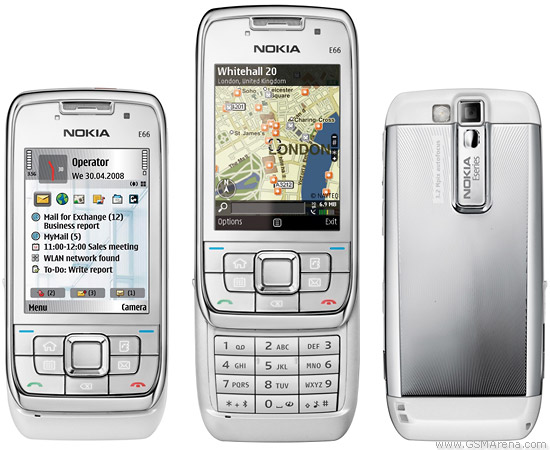
| Nokia E66 CHARACTERISTICS | |
| General | Network | GSM900 / GSM1800 / GSM1900 / HSDPA |
| Introduced | 2008 Q2 | |
| Status | Available | |
| Form factor | Slider | |
| Antenna | Internal | |
 | ||
| Size | Weight | 121 g (including battery) |
| Dimensions | 107 x 49 x 13 mm | |
| ||
| Display | Type | Graphical |
| Colours | TFT, 16M colors | |
| Size | 320 x 240 pixels | |
| | - Five-way scroll key | |
| ||
| Memory | Outgoing Calls | 30 |
| Received Calls | 30 | |
| Lost Calls | 30 | |
| Shared Memory | 110 MB | |
| | - microSD slot card (up to 8GB), hotswap - Photocall - 128 MB SDRAM Memory - ARM 11 369 MHz processor | |
| ||
| Ringtones | Polyphonic | Yes |
| | - Monophonic, MP3, True Tones | |
| ||
| Networking | GPRS | Yes, Class 32, 100 kbps |
| Modem | Yes, EDGE, Class 32, 296 / 177.6 kbps | |
| 3G | Yes, HSDPA, 3.6 Mbps | |
| WLAN | Yes, WLAN 802.11b/g | |
| USB | Yes, 2.0, microUSB | |
| Bluetooth | Yes, 2.0 + EDR, A2DP | |
| WAP | Yes | |
| Browser | Yes, WAP 2.0/xHTML, HTML | |
| Infrared | Yes | |
| Email Client | Yes | |
| | - Symbian OS 9.2, Series 60 v3.1 UI - Instant Messaging - Push to talk | |
| ||
| Features | Vibration | Yes |
| SMS | Send / Receive | |
| MMS | Send / Receive | |
| Camera | Yes, 3.2 MP, 2048x1536 pixels, flash, autofocus, QVGA video recording (VGA 22fps), secondary videocall camera | |
| Java | Yes | |
| Changeable Games | Yes | |
| Games | Yes | |
| Clock | Yes | |
| Alarm | Yes | |
| Calculator | Yes | |
| To-Do List | Yes | |
| Voice Dialing | Yes | |
| Voice Memo | Yes | |
| T9 | Yes | |
| Handsfree | Yes | |
| FM Radio | Yes | |
| | - Built-in A-GPS and Nokia Maps - MP3/AAC/MPEG4 player - Office applications - Blackberry connectivity | |
| ||
| Standard Battery | Type | Li-Ion |
| Amperage | 1000 mAh | |
| Standby Time | 264 hours | |
| Talk Time | 7 hours 30 minutes | |
Wednesday, August 6, 2008
Nokia E71 Phone
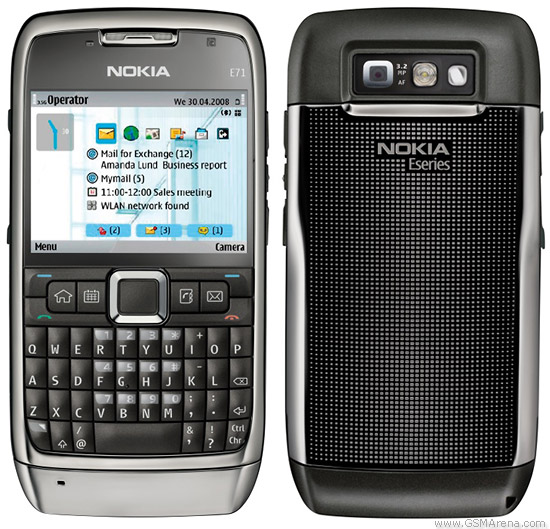
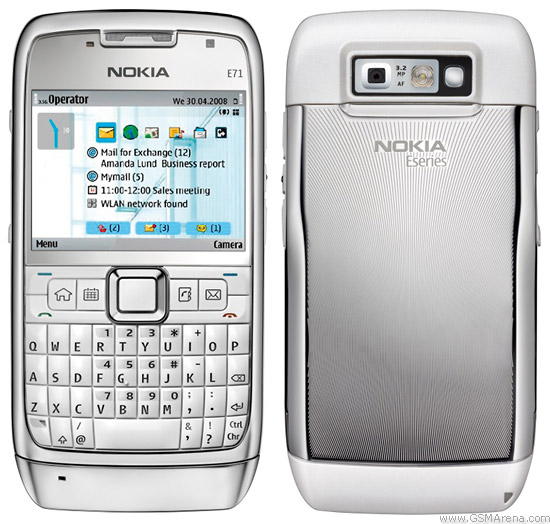
| Nokia E71 CHARACTERISTICS | |
| General | Network | GSM900 / GSM1800 / GSM1900 / GSM850 / HSDPA |
| Introduced | 2008 Q2 | |
| Status | Available | |
| Form factor | Block | |
| Antenna | Internal | |
| SAR Value | 1.33 W/Kg | |
| ||
| Size | Weight | 126 g (including battery) |
| Dimensions | 114 x 57 x 10 mm | |
| ||
| Display | Type | Graphical |
| Colours | TFT, 16M colors | |
| Size | 320 x 240 pixels | |
| | - Full QWERTY keyboard - Five-way scroll key | |
| ||
| Memory | Outgoing Calls | 30 |
| Received Calls | 30 | |
| Lost Calls | 30 | |
| Calendar Notes | Yes | |
| Shared Memory | 110 MB | |
| | - 128 MB SDRAM Memory - ARM 11 369 MHz processor - microSD slot card (up to 8GB), hotswap - Photocall | |
| ||
| Ringtones | Polyphonic | Yes |
| | - Monophonic, MP3, True Tones | |
| ||
| Networking | GPRS | Yes, Class 32, 100 kbps |
| Modem | Yes, EDGE, Class 32, 296 / 177.6 kbps | |
| 3G | Yes, HSDPA, 3.6 Mbps | |
| WLAN | Yes, WLAN 802.11g | |
| USB | Yes, 2.0, microUSB | |
| Bluetooth | Yes, 2.0 + EDR, A2DP | |
| WAP | Yes | |
| Browser | Yes, WAP 2.0/xHTML | |
| Infrared | Yes | |
| Email Client | Yes | |
| | - Symbian OS 9.2, Series 60 v3.1 UI - Push to talk - Instant Messaging | |
| ||
| Features | Vibration | Yes |
| SMS | Send / Receive | |
| MMS | Send / Receive | |
| Camera | Yes, 3.2 MP, 2048x1536 pixels, flash, autofocus, QVGA video recording (VGA 22fps), secondary videocall camera | |
| Java | Yes | |
| Changeable Games | Yes | |
| Games | Yes | |
| Clock | Yes | |
| Alarm | Yes | |
| Calculator | Yes | |
| To-Do List | Yes | |
| Voice Dialing | Yes | |
| Voice Memo | Yes | |
| T9 | Yes | |
| Handsfree | Yes | |
| FM Radio | Yes | |
| | - Built-in A-GPS and Nokia Maps - MP3/AAC/MPEG4 player - Office applications - Blackberry connectivity | |
| ||
| Standard Battery | Type | Li-Po |
| Amperage | 1500 mAh | |
| Standby Time | 408 hours | |
| Talk Time | 10 hours 30 minutes | |
Nokia 7610 Supernova


| Nokia 7610 Supernova CHARACTERISTICS | |
| General | Network | GSM900 / GSM1800 / GSM1900 / GSM850 |
| Introduced | 2008 Q2 | |
| Status | Coming soon | |
| Form factor | Slider | |
| Antenna | Internal | |
| SAR Value | 0.54 W/Kg | |
| ||
| Size | Weight | 99 g (including battery) |
| Dimensions | 98 x 48 x 15 mm | |
| ||
| Display | Type | Graphical |
| Colours | TFT, 16.7M colors | |
| Size | 320 x 240 pixels | |
| | - Five-way Navi Key | |
| ||
| Memory | Outgoing Calls | 30 |
| Received Calls | 30 | |
| Lost Calls | 30 | |
| Shared Memory | 64 MB | |
| | - microSD memory card, up to 2 GB (512 MB microSD card included) | |
| ||
| Ringtones | Polyphonic | Yes, 64 voices |
| | - Video, MP3, AAC, eAAC+ | |
| ||
| Networking | GPRS | Yes, Class 32, 100 kbps |
| Modem | Yes, EDGE, Class 32, 296 kbps | |
| USB | Yes | |
| Bluetooth | Yes, 2.0 | |
| WAP | Yes | |
| Browser | Yes, WAP 2.0/xHTML | |
| Email Client | Yes | |
| | - HSCSD as data modem (up to 28.8 kbps) - Symbian Series 40 3rd Edition UI - Nokia Audio Xpress messaging - Instant messaging with presence | |
| ||
| Features | Vibration | Yes |
| SMS | Send / Receive | |
| MMS | Send / Receive | |
| Camera | Yes, 3.2 MP, 2048x1536 pixels, dual flash, autofocus, CIF and VGA video recording (15fps), 8x digital zoom | |
| Java | Yes | |
| Changeable Games | Yes | |
| Games | Yes | |
| Clock | Yes | |
| Alarm | Yes | |
| Calculator | Yes | |
| To-Do List | Yes | |
| Voice Dialing | Yes | |
| Voice Memo | Yes | |
| T9 | Yes | |
| Handsfree | Yes | |
| Changeable Faces | Yes | |
| FM Radio | Yes | |
| | - 2.5 mm AV connector - TV out - Music player (MP3, AAC, and eAAC+) - Theme Colouriser - Yahoo! Go | |
| ||
| Standard Battery | Type | Li-Ion |
| Amperage | 860 mAh | |
| Standby Time | 300 hours | |
| Talk Time | 5 hours 40 minutes | |
| ||
Samsung new launch - i850 INNOV8


| General | Network | GSM900 / GSM1800 / GSM1900 / GSM850 / HSDPA |
| Introduced | 2008 Q3 | |
| Status | Coming soon | |
| Form factor | Slider | |
| Antenna | Internal | |
| ||
| Size | Dimensions | 106.5 x 53.9 x 17.2 mm |
| ||
| Display | Type | Graphical |
| Colours | TFT, 16M colors | |
| Size | 240 x 320 pixels | |
| | - Accelerometer sensor for auto-rotate - Optical Mouse | |
| ||
| Memory | | - 8/16 GB internal memory - 128 MB RAM - microSD (TransFlash), up to 8GB |
| ||
| Ringtones | Polyphonic | Yes |
| | - MP3 | |
| ||
| Networking | GPRS | Yes, Class 10 (4+1/3+2 slots), 32 - 48 kbps |
| Modem | Yes, EDGE, Class 10, 236.8 kbps | |
| 3G | Yes, HSDPA 7.2 Mbps | |
| WLAN | Yes, Wi-Fi 802.11 b/g, DLNA | |
| USB | Yes, 2.0 | |
| Bluetooth | Yes, 2.0 with A2DP | |
| WAP | Yes | |
| Browser | Yes, WAP 2.0/xHTML, HTML | |
| Email Client | Yes | |
| | - Symbian OS v9.3, Series 60 rel. 3.2 - Instant Messaging - Push Email | |
| ||
| Features | Vibration | Yes |
| SMS | Send / Receive | |
| MMS | Send / Receive | |
| Camera | Yes, 8 MP, 3264x2448 pixels, autofocus, image stabiliser, video(VGA@30fps, QVGA@120fps), flash; secondary videocall camera | |
| Java | Yes | |
| Changeable Games | Yes | |
| Games | Yes (2): FIFA 2008, Asphalt | |
| Clock | Yes | |
| Alarm | Yes | |
| Calculator | Yes | |
| To-Do List | Yes | |
| Voice Dialing | Yes | |
| Voice Memo | Yes | |
| T9 | Yes | |
| Handsfree | Yes | |
| FM Radio | Yes | |
| | - Built-in GPS receiver - A-GPS function - Camera images geo-tagging - Smart reader, auto-panorama shot, smile shot, blink shot - DivX/H.263/H.264/WMV/MP4 player - Video editing - MP3/eAAC+/WMA/AMR/RealAudio player - 3.5 mm audio output jack - Organizer | |
| ||
| Standard Battery | Type | Li-Ion |
| Amperage | 1200 mAh | |
| Standby Time | 310 hours | |
| Talk Time | 8 hours 30 minutes | |
| ||
Subscribe to:
Posts (Atom)
Hit counter

Subscribe To Mobile Retailing


 Posts
All Comments
Posts
All Comments